What to Check Before Buying a Sofa You Cannot Sit On
A sofa can look calm, balanced and expensive in a showroom, yet still be wrong for a Singapore home. The seat may feel too deep after 30 minutes. The arms may crowd a dining table. The back may scrape a corridor wall during delivery. Even a handsome solid wood sofa can become awkward if nobody checks its dimensions, access route and return terms before payment.

Living in HDB flats and private condos makes these checks more practical. A model that suits a living room in Tampines may not turn cleanly at a Bedok lift landing. A deep three-seater may overwhelm a Punggol dining corner. GST, delivery charges and lift fees can also change the final figure shown at checkout.
This guide explains how to assess a sofa without relying on appearance alone. The same disciplined approach can help when choosing a bed frame, especially if you are comparing phrases such as best American bed for 2026 or deciding between a light luxury bed vs Nordic bed. Measurements matter more than a style label.
Can You Reach Your Living Room With the Sofa?
Begin with the route, not the showroom. Measure the sofa's packed dimensions and weight, then measure every narrow point between the shop, van and living room. Include the doorway, corridor turn, staircase, lift door, lift car and any horizontal landing.
Many HDB common corridors are about 150 cm wide, although individual blocks differ. Some lift cars measure roughly 110 cm by 140 cm. A sofa wider than 140 cm may enter a lift front-first but prevent the carrier from turning it sideways. Measure the lift lobby as well: a 180 cm lift car is less useful if the landing turns sharply just outside.
For a condo, ask about the loading bay, parking approach and service lift reservation. A standard passenger lift may be avoided because its internal diagonal is too small for a bulky frame. Some buildings also require protective floor covering or restrict furniture delivery to designated hours.
Ask the seller for the sofa's largest packed dimension, not merely its assembled width. Remove loose cushions if permitted, but do not assume that a detachable cushion solves a fixed-frame problem. Check whether legs can be removed and whether the back can tilt without being permanently fixed.
I learned this during a flat move last month. I visited a client in Bedok after a two-seater had already passed the corridor. The lobby was 160 cm wide, but the lift door opened onto a 120 cm recess. The sofa could not rotate into the car. We had to bring it back up two flights of stairs, adding S$180 and leaving marks on 2 wooden handrail sections. Measuring the route would have prevented the entire delay.
Before paying, photograph the route and send the measurements to the retailer. Obtain a written delivery assessment. If access is uncertain, choose a sofa with a narrower arm, removable legs and a compact packed depth. A sectional may require two people even when its individual sections fit.
Does the Seating Depth Suit Your Body and Room?
A sofa that cannot be sat on comfortably at the showroom may be even less comfortable at home. Check seat height, usable depth, back angle and cushion firmness. The displayed configuration may not match the model being sold.
A useful rule is 43–48 cm of usable seat depth for a 45–50 cm seat height, although personal preference matters. A deep 60–68 cm seat lets you recline, but an adult of 170 cm may not place their back against the rear cushion without slouching. A low 40–43 cm seat can encourage upright posture, though it may feel high for a shorter user.
Sit for at least 15 minutes, not 60 seconds. Keep both feet planted and your lower back near the cushion. Try crossing your legs, leaning sideways and reaching a cup from the middle seat. If the front edge presses behind your knees after 10 minutes, the depth is probably excessive.
Check foam density and filling layers rather than relying on a vague claim of “high resilience”. Ask for the seat-core density in kg/m³ and the cushion thickness in cm. A reversible seat cushion should have at least 14 cm of comfortable filling, while a fixed bench cushion may need close inspection along its front edge. In humid conditions, loose covers that unzip and foam that can be replaced offer practical long-term value.
For a small HDB living room, a 160–185 cm two-seater may leave better circulation than a 220 cm three-seater. Leave at least 75–90 cm between the sofa and coffee table. Maintain about 60 cm beside a major seat for a person to pass. Those figures help prevent the room from becoming visually crowded.
Light-luxury design is not only about pale finishes and curved arms. French light luxury often introduces relaxed upholstery and elegant profiles, while American light luxury emphasises generous proportions. Post-modern light luxury may use cleaner lines and restrained contrast. Whichever direction appeals to you, the sofa must still fit your body and building.
What Does the Solid Wood Frame Reveal?
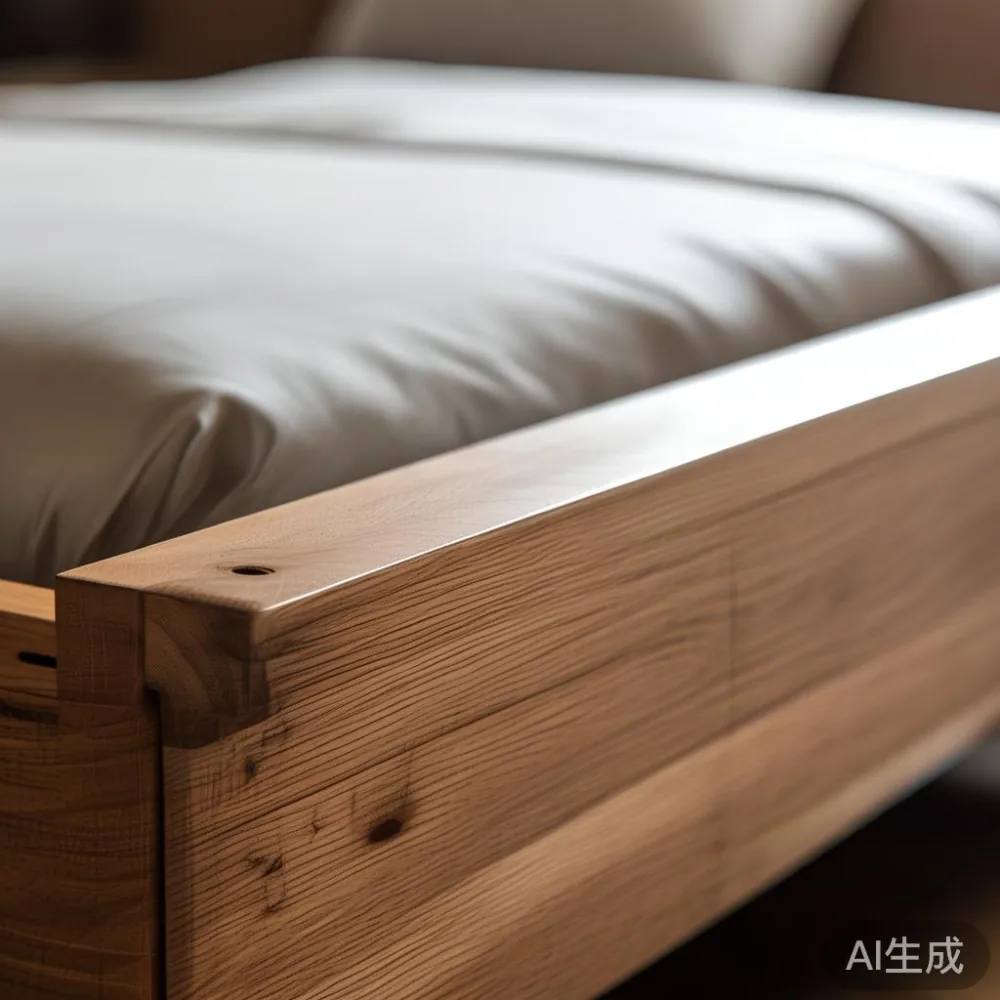
Inspect the frame where the cushions allow it. A solid wood sofa should identify the timber species and frame construction, not simply display a photograph of wood in the showroom. Common specifications may include kiln-dried oak, ash, beech or rubberwood, but hardwood naming alone does not confirm durability.
Look for joints held with dowels, screws and corner blocks where appropriate. Avoid accepting a frame with only staples joining thin rails. Check that the front rail is continuous or properly braced, and that the back structure is stable when you press forward at shoulder height. A frame should show no side-to-side wobble after the sofa has been moved.
Ask what “solid wood” excludes. Plywood may still appear in a compliant mixed construction for curved or non-load-bearing panels, while engineered board may be used behind the rear backrest. The important point is transparency: the seller should explain each material rather than implying that every hidden component is timber.
Floor-level tests matter. Sit in each section with weight shifted toward one arm, press the arm inward gently and stand at the front corner. Listen for knocking, creaking or movement under the rail. A decorative sofa may use metal springs or webbing rather than a timber-only suspension, so ask how the deck is supported.
Confirm floor protection. Felt pads should sit under every leg, and plastic caps should be removed from a timber floor. Ask whether adjustable feet can compensate for slopes. A 1–2 mm gap may look small in a showroom but can create visible instability beside a tightly fitted wall.
MIDHILL frames are backed by a 10-year structural warranty, which gives buyers a clearer point of reference than a general promise. Ask for the warranty document before ordering and understand what it covers, such as structural failure, and what it excludes, such as accidental damage or ordinary cushion compression.
What Does the Upholstery Do in Singapore's Humidity?
Singapore's year-round humidity can encourage mould, odours and fabric distortion. Ask whether the upholstery is removable, washable and replaceable. Removable seat and back covers can be valuable in a condo with direct morning sun, particularly if a window treatment allows several hours of light each day.
Check the fabric composition and abrasion rating. A tightly woven polyester or performance blend may resist everyday use better than an untreated linen with a loose weave. “Performance fabric” is not one regulated fibre type, so request the actual composition, care instructions and warranty treatment.
Do not rely on a colour swatch alone. View at least a 20 cm section under the room's likely lighting. Hold it near a white wall and compare it with your flooring. Light colours can look warmer under yellow bulbs and cooler beside blue-grey paint. If a made-to-order textile is offered, request a large sample and allow 7–14 days for evaluation.
Test colourfastness only according to the supplier's instructions. Rubbing a wet cloth informally may damage the finish and produce a misleading result. Ask for documented cleaning codes and whether spot-cleaning is permitted. A code such as “W” indicates water-based cleaner, while “S” indicates solvent-based cleaner, but upholstery care still follows the specific product guide.
For homes with pets, request fabric with a 30,000–50,000 Martindale rating and realistic stain guidance. For high-traffic family use, ask about pilling, seam strength and replacement-cover pricing. A premium-looking cover should not cost S$400–S$700 per replacement without advance notice.
How Do Delivery, GST and Returns Change the Price?
Build the landed cost before comparing offers. Singapore prices normally include GST for consumer purchases, but confirm whether the displayed figure is GST-inclusive. Add delivery, carry-up, lift reservation, extended warranty and assembly charges separately.
For furniture, a delivery window may be 7–14 days after the item is ready. Custom upholstery can take 6–10 weeks. A stock sofa might arrive in 3–7 days, yet a weekend delivery surcharge can still change the total. Ask whether the stated time starts after payment, after stock confirmation or after a custom order is approved.
MIDHILL offers free shipping over US$350, but cross-border orders to Singapore can involve payment-conversion methods, local taxes, duty treatment and long-distance freight arrangements. Obtain the total payable in SGD, including any service or delivery amount. Do not convert an overseas threshold into an assumed Singapore saving without checking the quotation.
Returns require close attention because made-to-order furniture may be excluded. Confirm whether a 14-day return period applies after delivery, what condition the sofa must be in and whether a restocking fee applies. The advertised 14-day returns policy should be read together with the product-specific terms.
Inspect the sofa before the delivery team leaves. Check upholstery stains, frame movement, odours, missing cushions and damage to timber legs. Photograph all sides before signing. Record any issue on the delivery note, not only in a chat message.
A showroom deposit of S$200 may reduce flexibility more than that figure suggests. If a 5% cancellation charge applies, a S$2,400 order could lose S$120 even before delivery. Clarify cancellation deadlines, refund timing and bank-processing periods in writing.
Is the Style Appropriate Beyond Its Name?
A sofa label can borrow language from several design traditions. The same term may describe a traditional silhouette, modern proportions or a loose marketing description. Compare the frame profile, arm shape, stitching, leg treatment and cushion structure with examples you can verify.
A showroom may search broad ideas such as Mid-century modern for hotel, though a hotel's communal sofa has different cleaning and durability requirements from a family living room. Another useful comparison is Mid-century modern with storage. A sofa with a 30 cm wide hidden compartment can work beside a bed frame, but confirm the lid's load limit and whether the mechanism blocks everyday access.
For a coordinated apartment, consider furniture categories beyond the sofa only as room references. A dining table can influence the sofa's clearance, a wardrobe can determine the available wall length, and a nightstand can echo the sofa's timber tone. A marble table introduces cool visual contrast, but its weight should not encourage you to place a fragile accessory near the sofa's busy arm.
Keep the room coherent without forcing every item into one style. French provincial details may be paired with simpler bed frame lines, while Scandinavian forms often use pale timber and restrained ornament. A marble table can sit beside warm solid wood, provided scale and colour remain controlled.
Shopping around S$2,000 is common for a larger three-seater, although sizing, fabric and custom work create wide differences. A compact two-seater may cost S$1,200–S$1,800, while a made-to-order upholstered sofa may exceed S$3,500. Compare specifications at similar prices rather than assuming one construction is more luxurious.
What Is Your Final 10-Minute Checklist?
Before paying, verify 10 items:
1. The usable seat depth is 45–55 cm and feels comfortable for 10 minutes.
2. The assembled dimensions fit the intended wall and circulation route.
3. The packed dimensions fit the narrowest lift, landing and doorway.
4. The frame timber, suspension and joint method are documented.
5. The fabric composition, cleaning code and abrasion rating are supplied.
6. Leg height suits a 40–50 cm seat height and does not damage the floor.
7. The total price in SGD includes GST, delivery, lift service and installation.
8. The delivery window is 7–14 days, or 6–10 weeks for custom work.
9. Deposit cancellation, 14-day returns and structural-warranty terms are understood.
10. You have photographed the room, route and sofa specifications before payment.
A show sofa has to earn its place through touch, movement and arithmetic. Test it for 15 minutes, inspect what happens beneath the cushions, and walk the sofa's route through the building in your mind. If a design term such as under 2000 French provincial furniture catches your attention, pause before assuming the finish or construction suits Singapore conditions.
Luxury Modern light luxury furniture can be expressive, but proportion and service still set the experience. Ask exact questions, retain written records and compare materials rather than labels. A well-chosen sofa should still feel supportive after the showroom visit, the delivery morning and the first long family evening at home.