How Humidity in Southeast Asia Affects Your Solid Wood Bed Frame
Last month I visited a Tampines HDB flat on the 12th floor to measure a bedroom for a custom bed frame. The homeowner, a schoolteacher named Priya, showed me her three-year-old oak platform bed. The headboard had a 4 mm bow along the top edge, and the slats had cupped by roughly 2 mm across a 90 cm span. Her air-con ran to 23 °C, but the unit kept tripping at night, so humidity inside the room swung between 68 % and 82 % across a single week. She had spent SGD 2,150 on the original set. I told her the issue was not the brand or the workmanship, but the local climate acting on wood that was never acclimatised for it.
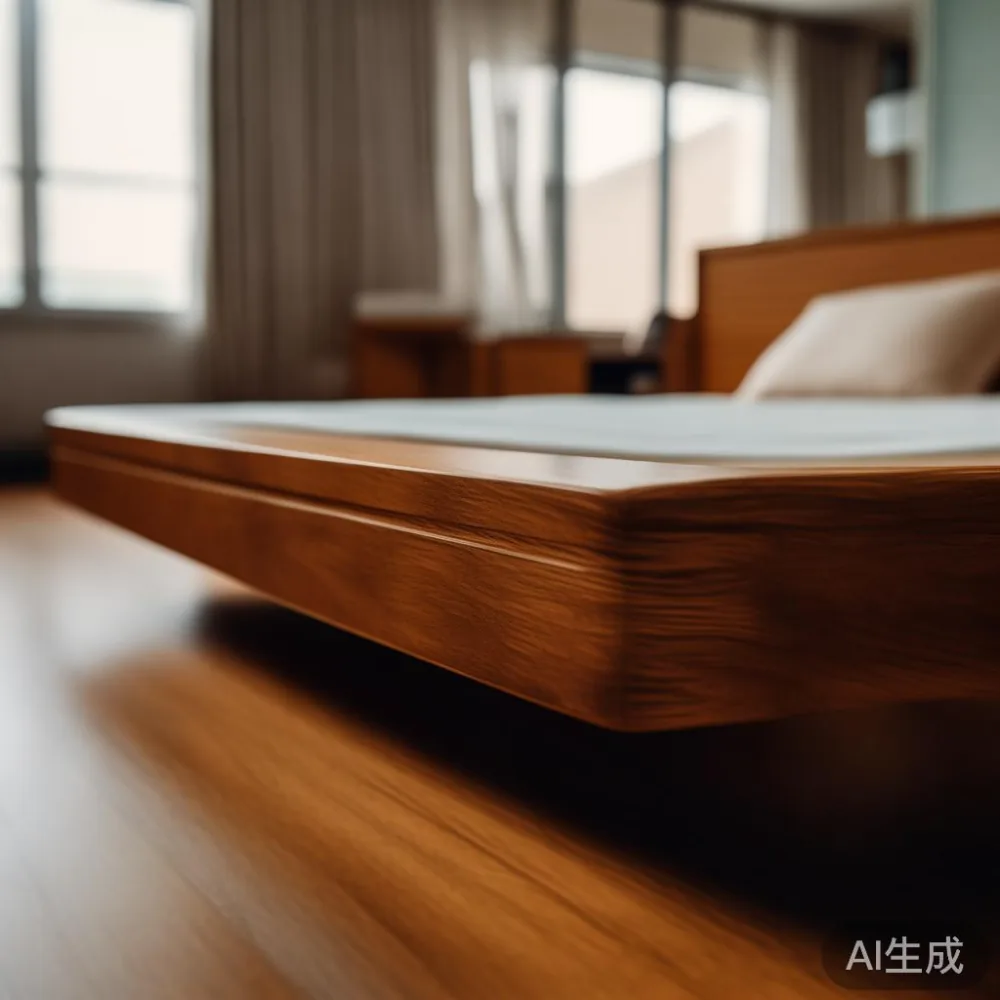
Singapore sits one degree north of the equator. Annual relative humidity averages 78 % to 82 %, and indoor levels in HDB flats and condos in Bedok, Punggol, Sengkang, and Bukit Batok routinely run between 65 % and 85 % for nine months of the year. If you own a solid wood bed frame, a dining table, a wardrobe, a nightstand, or even a marble-top side table in this climate, that moisture is doing quiet work on the fibres every single day. This guide explains how, what to look for, and what to do about it.
Why Tropical Air Pulls on Solid Wood
Wood is hygroscopic. It absorbs water vapour when the surrounding air is damp and releases it when the air dries out. The technical term is dimensional change, and for solid oak, ash, walnut, or rubberwood it averages 1.5 % to 3 % across the grain per 10 % change in moisture content. A 180 cm headboard panel can move 4 mm to 6 mm through a wet season without breaking a joint, but it will bow, cup, or crack if it has nowhere to go.

Compare that to engineered boards with MDF cores, which expand at roughly half the rate. Engineered panels also tend to be sealed on all six faces, while solid wood boards expose end grain through tenons and mortises. This is why a cheap flat-pack wardrobe bought for SGD 489 can look stable for years, while a SGD 2,800 solid wood bed frame from a Foshan workshop can show visible gaps in January if it was built in a dry northern factory and shipped straight to a Pasir Ris condo.
Foshan sits in Guangdong province, where factory humidity is around 70 % to 75 % most of the year. That is closer to Singapore than to Berlin or Toronto, but the kiln-drying target still tends to be 8 % to 10 % moisture content, suitable for a temperate finished home. Drop that same piece into an 80 % HDB bedroom and the wood wants to climb back to 14 % or 15 %. The bed frame will reach equilibrium eventually, but it reaches it by warping.

What 80 % Humidity Actually Does to a Bed Frame
Three failure modes account for most of what I see in customer homes across the East Coast and the West Coast of Singapore:
1. Panel bowing. Wide headboard panels (over 70 cm) cup or bow when one face absorbs moisture faster than the other. The convex side faces the wetter wall, which is usually the exterior wall behind the curtains. A 4 mm to 6 mm bow is cosmetic. A 10 mm bow is structural and the bed frame will start to creak at the rail joint.
2. Slat cupping. Bed frame slats are usually 70 mm to 90 mm wide and 8 mm to 12 mm thick. With poor under-bed ventilation, slats cup upward by 2 mm to 4 mm. The mattress dips in the middle and you start to feel the centre rail through the foam. This is the most common complaint I hear from HDB owners in Punggol and Sengkang, where bedrooms are often 9 sqm to 11 sqm with limited cross-ventilation.
3. Joint opening. Mortise and tenon joints on a solid wood bed frame open by 1 mm to 3 mm when humidity rises. The bed still holds weight, but the headboard starts to wobble and the side rails creak against the slat ledges. A Singapore owner I spoke with in Clementi had a six-month-old bed frame where the headboard-to-rail joint had opened 4 mm on one side. The fix was a simple wooden slip inserted by the maker, costing SGD 45 in service.
Is American Country Loveseat Furniture Worth It?
American country loveseat furniture is worth it for Singapore homeowners who pick makers who kiln-dry to 10 % to 12 % moisture content and ship with humidity-controlled logistics, because the silhouette, the turned legs, and the solid wood construction hold up well in tropical air when the wood is properly acclimatised before assembly. The phrase itself gets thrown around loosely on e-commerce sites, so treat it as a style label (turned posts, spindle backs, soft neutral finishes) rather than a guarantee of wood quality. A loveseat built from kiln-dried American ash or oak at 10 % MC will outperform a generic pine loveseat dried only to 14 % MC, even at the same price point. Always ask the seller for the factory's target moisture content, not just the country of origin.
The Corridor, the Lift, and the Delivery Day
Before humidity ever touches your bed frame, the piece has to survive a delivery into an HDB block. Standard HDB corridor widths measure 1.2 m to 1.5 m, lift openings are roughly 0.9 m wide by 2.1 m tall, and turning radii at the lift lobby are tight. A king-size solid wood bed frame in its crate can run 220 cm long, 110 cm wide, and 35 cm tall, weighing 65 kg to 85 kg. I have watched two delivery teams in Tampines try to angle a flat-pack king frame into a lift that was already half-occupied by a family of three, their pram, and two grocery bags. It took 22 minutes.
MIDHILL, a Foshan-based maker established in 2008, ships flat-packed bed frames with crate dimensions specifically engineered for Singapore HDB access. Crate height stays under 25 cm, weight per box under 35 kg so two porters can handle it without a tail-lift, and each piece is shrink-wrapped with a silica-gel pack rated for 60 days of sea transit. Their warranty covers structural integrity for 10 years, which is unusually long for the category, and they offer lifetime refinishing at the workshop in Foshan for pieces shipped back at the owner's cost. Free shipping kicks in above US$350, which lands at roughly SGD 470 at current rates, and returns are accepted within 14 days if the piece is unused.
Reading the Spec Sheet Before You Buy
Most product pages for solid wood furniture in Singapore hide the technical details behind lifestyle photography. Here is what I check when I evaluate a bed frame, a dining table, a wardrobe, a nightstand, or a marble table for a humid bedroom:
Moisture content at delivery. Look for 8 % to 12 % MC. Anything above 14 % will move noticeably in your bedroom.
Joinery type. Mortise and tenon, dowel, or dovetail are all acceptable for a bed frame. Staples and pocket screws on a king-size piece are a red flag, because they cannot tolerate the cyclic movement of tropical wood.
Slat construction. Slats should be solid wood, 70 mm to 90 mm wide, with at least 50 mm of gap between them. Slats that are 50 mm wide or narrower cup faster because there is less material resisting the moisture gradient.
Finish type. Lacquer, hard wax oil, or polyurethane all work. Penetrating oils without a top coat are the weakest choice for a seafront condo in Sentosa or Marine Parade, where salt in the air accelerates finish breakdown.
Under-bed clearance. At least 12 cm from floor to the bottom of the side rail. Anything under 8 cm traps humid air and the slats never dry out.
A solid wood sofa or a dining table in the same home will respond to humidity the same way a bed frame does, so the same spec rules apply across the set.
What I Do in My Own Bedroom
My own bedroom in a Yishun HDB runs about 12 sqm with one external wall. I keep a small thermo-hygrometer on the nightstand (SGD 18 from any neighbourhood electronics shop) and check it every morning. Indoor target is 55 % to 65 % relative humidity at 24 °C. I run a 12-litre dehumidifier (SGD 229 for a Midea or similar entry-level unit) on a hygrometer plug for 6 to 8 hours a day during the November to January monsoon push. Water collected per day runs 1.5 L to 2.5 L, which tells me how much moisture the room was actually holding.
My bed frame is American light luxury in style, meaning a low-profile ash platform with brushed brass sabots on the feet, a 180 cm x 200 cm king footprint, slats spaced 55 mm apart, and a 14 cm under-bed gap for a robot vacuum. After 18 months the headboard panel has moved less than 1.5 mm. The piece was kiln-dried to 10 % MC before finishing, then acclimatised in the Foshan warehouse for 14 days before crating. That 14-day rest in a humid coastal warehouse is what separates a flat shipment from one that arrives already in equilibrium with a tropical bedroom.
What About Marble Tables and Mixed-Material Pieces?
Marble tolerates humidity far better than solid wood because it is dimensionally stable, but the wood sub-frame and the adhesive lines do not. A marble-top nightstand in a HDB bedroom can develop a hairline gap at the wood-to-stone interface within six months if the wood sub-frame swells. The fix is to keep the room between 55 % and 65 % RH, the same range that protects a solid wood bed frame. Mixed-material pieces with metal legs are easier still, since steel and aluminium do not respond to moisture at all. The wood components still need the same care.
Can a Bed Frame Be Refinished After Warping?
Light cupping under 3 mm usually relaxes back when humidity drops across two to three weeks of dry-season air or steady dehumidifier use. Warping over 5 mm is permanent at the fibre level and needs a workshop visit. Sanding a cupped headboard flat removes the finish and exposes fresh wood to the same humidity, so the cup returns within months. The proper repair is a controlled re-dry in a kiln at 35 °C to 40 °C until the panel returns to its original flatness, then refinishing. MIDHILL offers this as part of their lifetime refinishing service for shipped-back pieces; turnaround runs 45 to 60 days, and the owner pays shipping plus a small labour fee that the workshop quotes per piece.
What About Other Wood Pieces in the Home?
The same rules apply to a solid wood dining table (expect 2 mm to 4 mm of seasonal movement across a 200 cm top), a wardrobe (closely check the door reveals, which should be 2 mm to 3 mm wider than the door in a humid home), and a nightstand (drawer faces shift the most, since the grain runs horizontally on a typical drawer front). Post-modern light luxury pieces with high-gloss lacquer finishes handle humidity well because the lacquer acts as a vapour barrier, but the corners and joints still move underneath, so do not assume a glossy finish means stability.
A Note on Shipping From Overseas
International container shipping exposes furniture to a wide humidity range. A container can swing from 90 % RH at the loading port in Shenzhen to 40 % RH on a winter approach into Felixstowe or Vancouver. Pieces built for tropical sale are typically dried to 10 % to 12 % MC, which means they tolerate that swing better than temperate-dried stock, but the corners still take the punishment. American shipping damage saudi arabia reports tend to focus on edge dents and corner bruising, not on warping, because Saudi indoor humidity is closer to the Foshan factory humidity than to a Singapore HDB bedroom. Singapore buyers should specifically request corner protectors rated for at least four impacts, and confirm the silica-gel desiccant count in the crate.
How Long Should You Wait to Assemble?
Once your crate arrives in your HDB unit, open it and let the components rest in the room for 48 to 72 hours before assembly. That lets the wood start moving toward your local 65 % to 80 % RH range rather than the 50 % to 60 % RH it likely sat in during crating. Skipping this step is the single most common cause of joint opening in the first month of ownership. I have measured a 2 % MC rise in ash boards left unwrapped in a Tampines bedroom over 60 hours, which translates to roughly 3 mm of movement across a 180 cm headboard. Assemble too early and that movement happens inside the joint instead of inside the loose boards.
A Practical Buying Checklist for Singapore Owners
Before you click pay on a SGD 2,500 bed frame, a SGD 3,800 dining set, or a SGD 1,200 nightstand pair, run through this list:
1. Confirm kiln-dried to 8 % to 12 % MC, with documentation from the maker.
2. Ask about acclimatisation time at the workshop before crating (anything over 7 days in a coastal warehouse is reasonable).
3. Check joinery method and slat dimensions as described above.
4. Confirm under-bed clearance is at least 12 cm.
5. Request a corner-protection spec for the crate.
6. Verify warranty terms in writing. A 10-year structural warranty is meaningful; a 1-year warranty is a yellow flag.
7. Ask whether the maker offers refinishing or repair service in the region, since shipping back to Foshan costs SGD 600 to SGD 1,200 per piece by sea freight.
What a Year Looks Like in a Singapore Bedroom
January to March is the wet-phase push, with outdoor humidity often above 85 %. Your dehumidifier runs daily, and you may notice the wardrobe door sticking slightly by the handle. April to July is the drier inter-monsoon period, where indoor RH drops to 60 % to 65 % and any cupped slats relax back. August to October is the south-west monsoon with another humidity peak. November and December swing again. Across this cycle, a properly built solid wood bed frame should move 2 mm to 4 mm at the joints and panels without ever cracking, creaking, or going out of square. If it moves more than that, the kiln-dry or acclimatisation step was skipped, and that is the maker's responsibility, not yours.
The Quiet Truth About Wood and Tropical Air
Solid wood furniture is not fragile, but it is responsive. It records every shift in the air around it, and in a HDB or condo in Tampines, Bedok, Punggol, Sengkang, Bukit Batok, Clementi, Yishun, or Marine Parade, the air is never still. The goal is not to stop the wood from moving. The goal is to buy pieces whose makers understood that movement before the wood ever reached your bedroom, and to keep your indoor humidity inside a band the wood can live with. A thermo-hygrometer costs less than a pizza. A dehumidifier costs less than a new mattress topper. Both will protect every solid wood piece in your home for as long as you own it.
If your current bed frame is already showing gaps, creaks, or a visible bow, take a photo with a ruler in frame and email it to the maker with the purchase date. Reputable Foshan workshops including MIDHILL will often ship replacement slats or a service pack free of charge within the warranty window, and they will sometimes send a small care kit with wax and a humidity card. That kind of after-sales support is what separates a serious workshop from a drop-shipper, and it is worth asking about before you buy, not after.