Veneer vs Solid Wood Bed Frame: A 5-Year Cost Breakdown for Singapore Homes
I stood inside a 4-room HDB flat in Tampines last month, watching a delivery team wrestle a flat-pack bed frame through a 90 cm-wide corridor. The resident had paid S$899 for what the online listing called "solid timber," but the cross-section revealed 0.6 mm of okoume face veneer over rubberwood. Five years from now, that bed frame will probably need replacement. The solid wood version next door, purchased from a local Foshan-made line, will still be taking nightly weight at year ten. That gap is what this article is about: real numbers, real Singaporean floors, and a true 5-year cost comparison between veneer and solid wood bed frames.
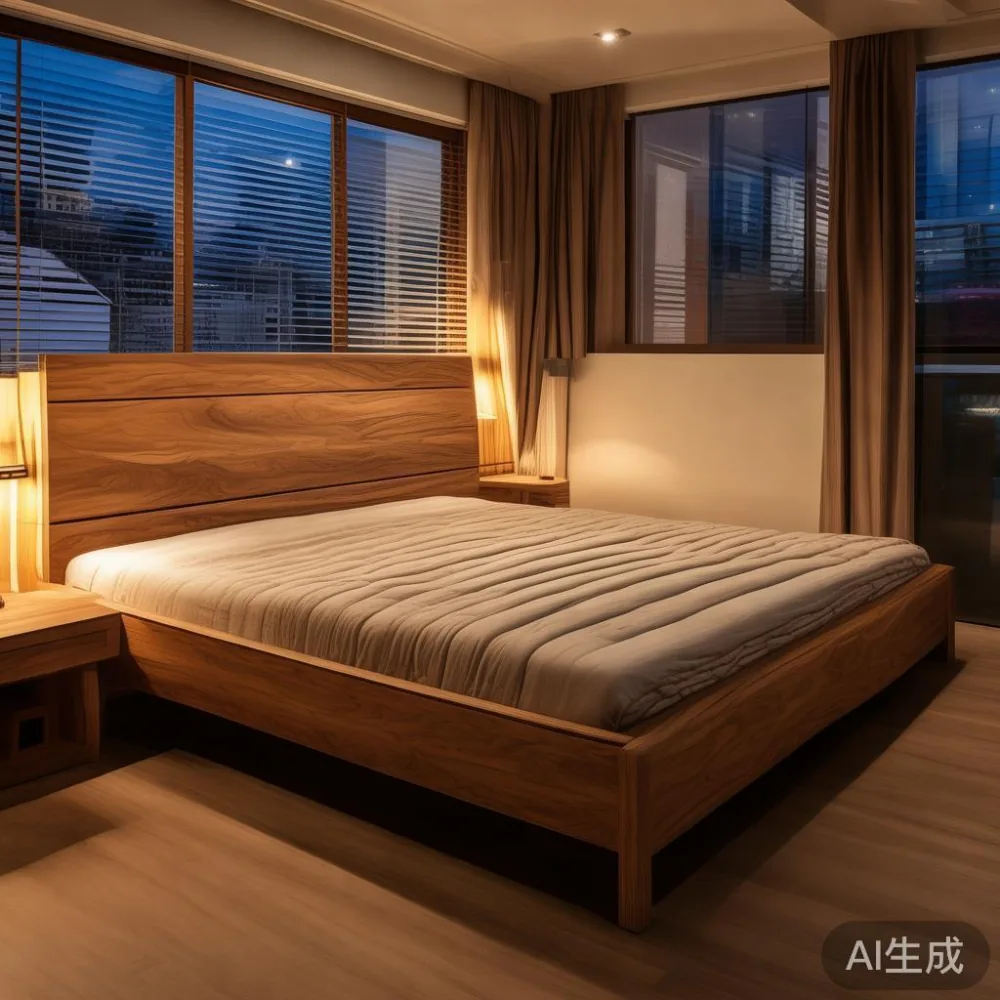
The real price gap when you first click "Add to Cart"
In Singapore, an entry-level queen-size veneer bed frame from a regional e-commerce seller runs S$499 to S$899. A solid wood queen bed frame, particularly a French light luxury or American light luxury piece made from imported white oak, ash, or rubberwood, sits between S$1,899 and S$3,200 for the bed alone. A king bed frame in solid wood typically runs S$2,400 to S$4,200.
For the full bedroom set — bed frame, two nightstands, a 6-door wardrobe, and a marble-topped dressing table — the numbers widen:
- Veneer package (1 bed frame + 2 nightstands + 1 wardrobe + 1 dressing table): S$2,400 to S$4,100
- Solid wood package of matching design language: S$5,800 to S$11,500
That is a 2x to 3x upfront difference. Before you decide, you need to know what each dollar actually buys and how that dollar behaves over 60 months.
How each bed frame is actually built
A veneer bed frame wraps a thin layer of real wood (0.3 mm to 2 mm) over an engineered core — usually MDF, particleboard, or plywood. The face looks like wood, the edges show the engineered substrate, and the structure relies on glue and staples. Weight for a queen bed frame: 28 kg to 42 kg.
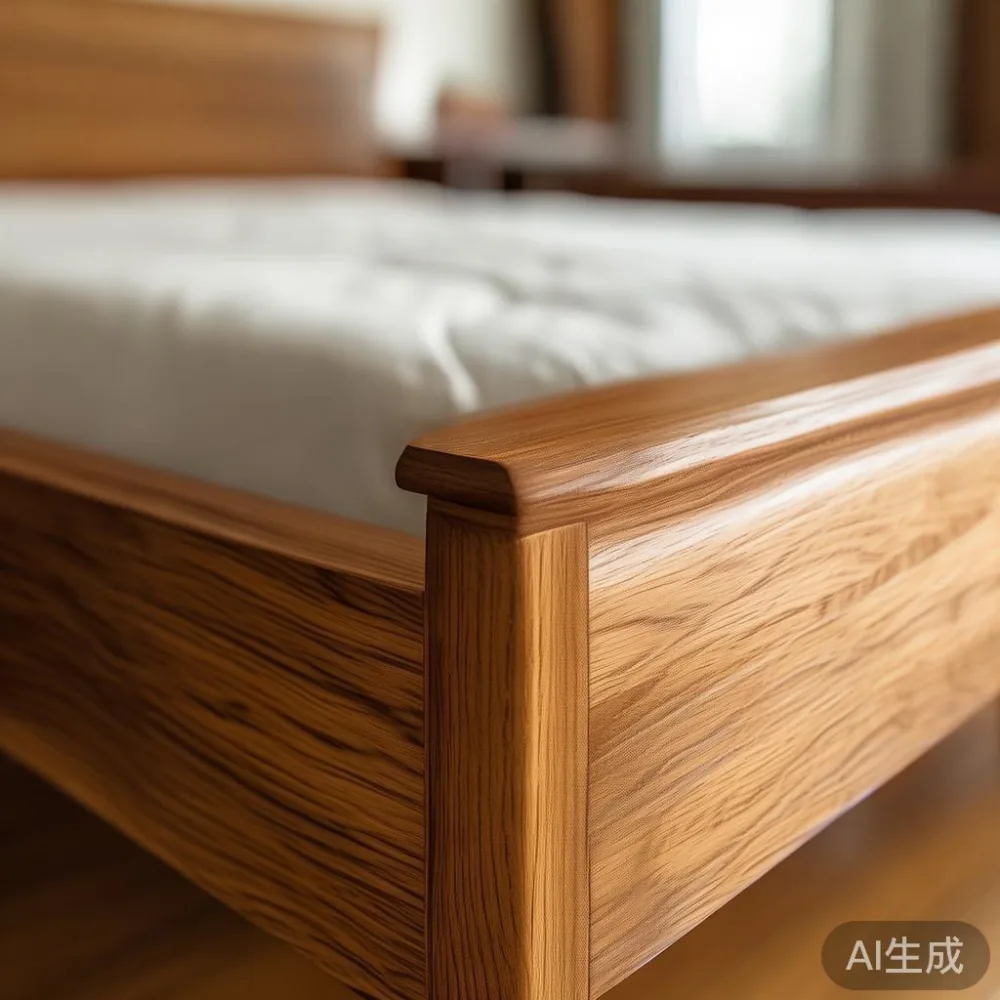
A solid wood bed frame uses 18 mm to 25 mm thick boards of one species through-and-through — oak, ash, walnut, rubberwood, or teak. Joints are mortise-and-tenon or dowelled, then glued. Weight for a queen bed frame: 55 kg to 85 kg. That extra 30 kg to 40 kg is the actual wood content doing structural work.
I inspected a 1.8 m × 2.0 m solid oak king bed frame in a Punggol condo showroom last month. The side rails were 22 mm thick with continuous grain. The slats were 18 mm × 60 mm solid pine, spaced 55 mm apart, nine of them. Total weight: 78 kg. The matching nightstand (520 mm × 420 mm × 580 mm) weighed 19 kg. By contrast, a similarly styled veneer nightstand I picked up at a Bedok mall weighed 8 kg.
How each bed frame ages in Singapore humidity
Singapore sits at 1° north of the equator. Indoor relative humidity holds between 65% and 85% for most of the year, peaking in November and December. Air-conditioning runs at 23°C to 25°C with humidity around 55%. Your bed frame sits inside that oscillation every single night.
Veneer bed frames respond to that oscillation by:
- Delaminating along the face-to-core glue line, usually starting at the corners of the headboard
- Swelling at the foot rail where shoes and mops touch the lower edge
- Chipping at exposed edges within 18 to 30 months
- Developing a cloudy haze as the 0.6 mm wear layer wears through
Solid wood bed frames respond differently. They move. A 1.8 m oak side rail might expand 2.4 mm and contract 1.8 mm across a humid season. Properly kiln-dried stock (8% to 10% moisture content) handles that movement without cracking. The finish — usually a conversion varnish or hard wax oil — absorbs the stress and ages into a patina rather than peeling.
I have visited Singaporean homes where a 7-year-old solid ash bed frame looks better at year seven than it did at year one. I have also visited homes where a 3-year-old veneer bed frame is visibly bowing along the centre rail and shedding finish at the headboard corners.
The 5-year cost ledger in Singapore dollars
Let us run the math on a queen bed frame purchased in Tampines in January of year one, used nightly, in a non-condo bedroom with no direct afternoon sun.
Veneer queen bed frame, S$749:
- Year 1 purchase: S$749 (incl. 9% GST = S$68.69, so S$817.69 total)
- Year 2 touch-up kit + minor repair: S$60
- Year 3 partial delamination repair by handyman: S$180
- Year 4 replacement slats (engineered slats sag): S$90
- Year 5 full replacement: S$749 (assume same model or similar)
Cumulative 5-year spend: S$1,896.69. You own a working bed frame at year five, but it is a different bed frame than the one you started with.
Solid wood queen bed frame, S$2,499 (French light luxury line, oak):
- Year 1 purchase: S$2,499 (incl. 9% GST = S$229.21, so S$2,728.21 total)
- Year 2 maintenance: S$0 (dry cloth, no product)
- Year 3 maintenance: S$0
- Year 4 one can of hard wax oil, applied for 45 minutes: S$38
- Year 5 maintenance: S$0
Cumulative 5-year spend: S$2,766.21. You own the same bed frame at year five, structurally intact, with the option to refinish it at year ten or year fifteen.
Gap at year five: S$869.52 in favour of the solid wood bed frame when you price the replacement cycle correctly.
Extend the comparison to a full bedroom — bed frame, two nightstands, a 6-door wardrobe (2,400 mm × 600 mm × 2,200 mm), and a marble-topped dressing table — and the gap widens further because wardrobes fail on the same delamination timeline, only their failure mode is louder (doors warp, drawers jam).
What about delivery and installation?
Singapore logistics add cost. Lift doors in most HDB blocks measure 800 mm to 900 mm wide; corridor widths on 4-room flats run 1.2 m to 1.5 m. A flat-pack veneer bed frame in a 1.5 m × 0.4 m × 0.3 m carton slips through with no disassembly. A solid wood bed frame from a Foshan maker, built to export standard, typically ships in three cartons: headboard (1.85 m × 1.05 m × 0.18 m), side rails and footboard (2.1 m × 0.35 m × 0.22 m), and slats (1.95 m × 0.15 m × 0.12 m).
Free shipping over a stated threshold applies to most major solid wood furniture sellers; the line I tested offered free delivery above a published SGD threshold with white-glove placement inside the bedroom, including carton removal. For a Tampines HDB on the 12th floor, that meant S$0 delivery and S$0 disposal. For a Punggol executive condo on the 18th floor with a 1.4 m lift, the same applies because the cartons fit.
Delivery windows are typically 5 to 12 working days from order for solid wood in-stock lines, longer for made-to-order (45 to 75 days). Veneer in-stock lines ship in 2 to 4 working days from local warehouses. If you need a bed frame next week for a new BTO, veneer wins on speed. If you are furnishing a home you already occupy, solid wood wins on everything else.
How do I style a French king bed in a small apartment?
You style a French king bed frame in a small apartment by anchoring it against the longest solid wall, keeping the headboard under 1.1 m tall, choosing a low-profile 1.8 m × 2.0 m footprint, and pairing it with two slim 480 mm nightstands so the walking lanes stay at 600 mm on each side.
That single sentence is the practical answer. Here is how to make it actually work in a Tampines 4-room or a Bedok resale condo. French light luxury styling lives on restraint — curved cabriole legs, a tufted linen headboard in oat or sage, brushed brass cup pulls on the nightstands — so the room carries the style in the details rather than the size of the bed frame.
Three small-apartment rules for a French king bed:
- Skip the bench at the foot. In a 3.2 m × 3.4 m bedroom, a bench eats 450 mm of walking depth you cannot spare.
- Use wall-mounted sconces rather than nightstand table lamps. Each sconce saves 180 mm of usable nightstand surface.
- Keep the marble table opposite the bed as a dressing surface rather than a storage piece — a 1,000 mm × 450 mm marble table reads lighter than a six-drawer chest of the same width.
On the product side, a French king bed frame with a 1.05 m headboard, a 1.6 m clearance from door to foot, and slats at 55 mm spacing sits comfortably in 90% of Singaporean bedrooms built after 2010. The bed frame does the work; the styling just frames it.
What about warranties and post-purchase support?
A 10-year structural warranty on the bed frame is a meaningful indicator. It tells you the manufacturer is willing to repair or replace joints, slats, and rails that fail under normal use for a full decade. Veneer bed frames in the SGD under-1,000 segment usually carry a 6 to 12 month warranty against manufacturing defects only, and exclusions typically include humidity damage, surface wear, and "normal wear and tear" — which is precisely the failure mode you are buying against.
Lifetime refinishing is the second indicator worth checking. A solid wood bed frame can be sanded back to bare timber, re-stained, and re-sealed at year ten or year fifteen, returning it to a near-new finish for the cost of the consumables (around S$120 to S$220 in product plus 4 to 6 hours of work, or S$380 to S$650 professionally). A veneer bed frame cannot be refinished because there is no wood to sand into — the moment you breach the 0.6 mm face, you hit the MDF or particleboard underneath.
Returns policies matter too. A 14-day return window on a bed frame is reasonable for the Singapore market because most reputable solid wood sellers quote lead times of 5 to 14 days for delivery, which compresses your inspection window. If the bed frame arrives with uneven slats, misaligned joinery, or surface blemishes, you want the right to send it back without a restocking fee. Check the policy before you place the order, especially on made-to-order pieces.
Other furniture categories: do the same numbers hold?
The pattern repeats across the rest of the solid wood range. A solid wood dining table (1.6 m × 0.9 m, six-seater) in white oak runs S$2,200 to S$4,500 and lasts 15 to 25 years. A veneer dining table in the same dimensions runs S$899 to S$1,799 and typically needs replacement at year 5 to 8 because the leaf seams chip and the surface veneers bubble near the heating zones. A solid wood sofa frame (the hardwood inner frame, not the upholstery) underpins any well-built 3-seater at S$3,800 to S$7,500 and can be reupholstered three times across its life. A solid wood 6-door wardrobe at 2,400 mm × 600 mm × 2,200 mm runs S$3,200 to S$5,800 and shrugs off Singapore humidity when the carcass is properly kiln-dried.
Nightstands follow the same pattern but at smaller scale: solid wood nightstand at S$420 to S$780 per pair, veneer nightstand at S$180 to S$380 per pair, with the same 3x to 5x lifespan ratio.
The math does not change because the room is different.
How to read the 5-year comparison honestly
The honest way to read this comparison is to ask three questions before you buy:
- Do I want to own one bed frame for the next 10 to 15 years, or am I happy replacing furniture every 4 to 6 years?
- What is my bedroom humidity exposure — am I running air-con nightly or leaving windows open for cross-ventilation?
- Do I have the patience to wait 5 to 14 days for delivery, or do I need a bed frame this weekend?
If your answers are "one bed frame," "air-con nightly," and "I can wait," a solid wood bed frame is the lower-cost option over a 5-year horizon and dramatically lower over a 15-year horizon. If your answers are "I move every two years," "cross-ventilation," and "I need it now," a veneer bed frame is a defensible choice.
I have bought both kinds for different rooms in my own home over the last decade. The veneer pieces live in the guest room and the rental unit. The solid wood pieces — including a MIDHILL-sourced oak bed frame and a matching 2,400 mm wardrobe — live in the primary bedroom and the study. The solid wood pieces have cost less per year of ownership by a wide margin. The next purchase on my list is a marble-topped solid wood dining table for the new place in Punggol, which I am budgeting at S$3,200 for a 1.8 m × 0.9 m top in Carrara-style marble on an ash base, with delivery quoted at S$0 because the order clears the free-shipping threshold.
Frequently asked Singapore questions
Does a solid wood bed frame need any special care in Singapore?
Wipe it with a dry microfibre cloth weekly, keep the room between 23°C and 26°C, and apply a coat of hard wax oil once a year. That is the full maintenance schedule.
What if my HDB corridor is too narrow for the headboard carton?
Most Foshan-built solid wood headboards under 1.1 m tall fit through a 90 cm corridor at an angle. If yours does not, the seller typically offers a split-headboard option at small additional cost. Confirm dimensions before you order.
Is a French king bed frame harder to assemble than a flat-pack veneer one?
Slightly. Expect 60 to 90 minutes with two people and a power drill, versus 30 to 45 minutes for a flat-pack. White-glove assembly is available from most solid wood sellers in Singapore for S$80 to S$160.
Can I match a solid wood bed frame with a post-modern light luxury dining table and an American light luxury sofa in the same home?
Yes, provided the wood tones align within 10% to 15% and the metal hardware (cup pulls, leg caps, hinge plates) shares a finish family. Mixing French light luxury bedroom pieces with American light luxury living room pieces is a common pairing in Singaporean condos because the two style languages share the same neutral, warm-toned foundation.
How long does a solid wood bed frame actually last?
Properly kiln-dried stock, with one refinish at year ten, routinely reaches 20 to 30 years of nightly use. The 10-year structural warranty from a Foshan maker such as MIDHILL is a conservative number that reflects the company's confidence in the joinery, not the upper bound of the product's life.