How to Care for a Lacquered Bed Frame in Singapore’s Humid Climate
Humidity, condensation, salty air, and frequent hand contact can make a lacquered bed frame look tired faster than its owners expect. In Singapore, a bedroom may experience 70–85% relative humidity during the rainy season, while afternoon temperatures can reach 32–34°C. A lacquered surface needs more than an occasional wipe. It needs a routine that accounts for the bed frame’s finish, the amount of airflow in the room, and the realities of HDB flats and condominiums in Tampines, Bedok, and Punggol.

At MIDHILL, we build and export solid wood furniture to more than 15 countries, so tropical care is not a minor afterthought for us. Our lacquered bed frames are supported by a 10-year structural warranty and a lifetime refinishing policy, yet correct surface care can preserve their appearance for many years. The goal is simple: keep moisture away from the finish, clean it gently, and address scratches before they become deep defects.
Why does lacquer need special care in Singapore?
A lacquer finish creates a durable barrier over the wood, but that barrier is not immune to heat, water, alkaline cleaners, or trapped humidity. In an HDB flat, a bed frame may sit close to an external wall, beside a sliding-door wardrobe, or in a room with limited cross-ventilation. During heavier rain, night-time condensation can form on cooler surfaces. Repeated wetting may leave water marks or encourage swelling beneath the lacquer.

Temperature changes matter too. A frame beside a window can heat up by 8–12°C over a day as sunlight strikes the glass. The finish expands and contracts more quickly than people expect, especially around joints, edges, and routed details. Repeated flexing can produce fine cracks if a heavy mattress is repeatedly dragged across the surface.
Use a hygrometer rather than guessing. Place it near the bed frame, not directly against an air-conditioner outlet. Readings between 45–60% relative humidity are comfortable for most solid wood furniture. Singapore can exceed 70% for extended periods, so a dehumidifier may be more useful than leaving the bedroom door open during the wettest hours.
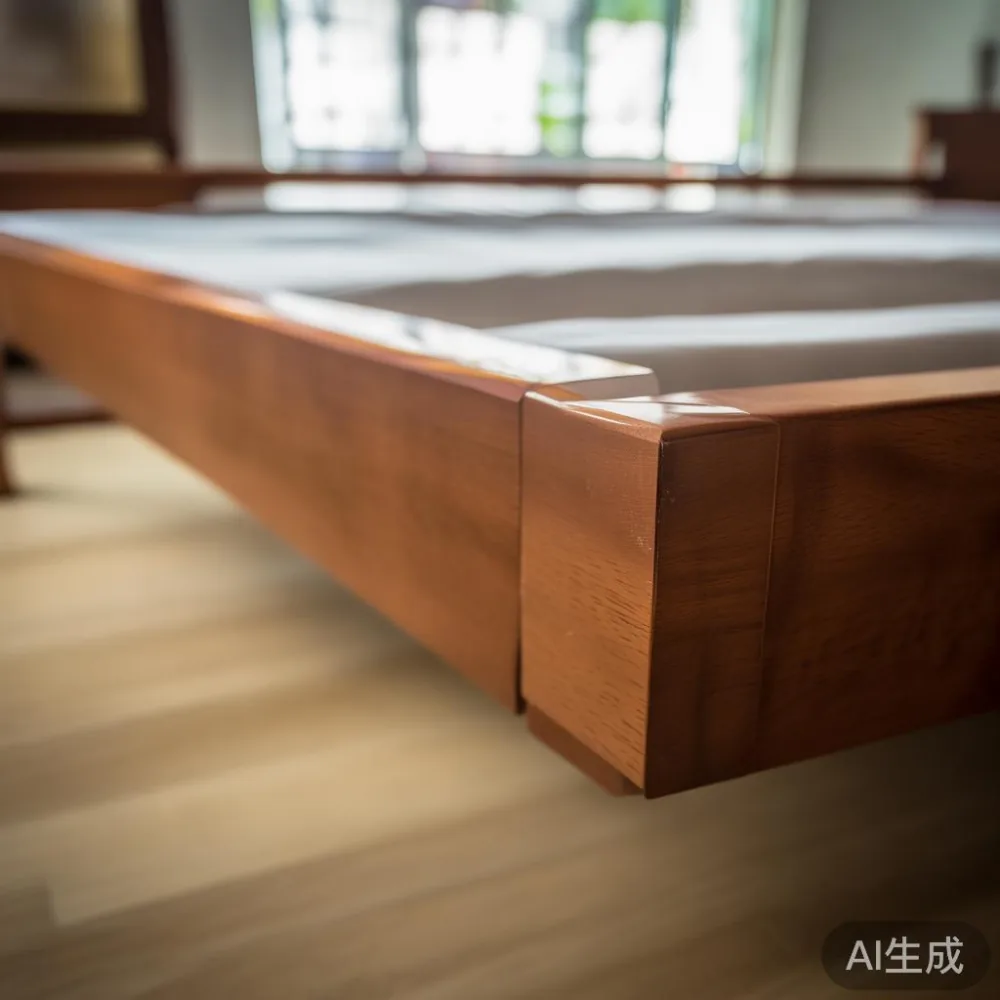
Air-conditioning lowers humidity, but it should not blow continuously across the bed frame. Set the room around 25–27°C when practical and redirect the louvres away from the headboard or footboard. If condensation appears, switch the fan or air-conditioner to Auto, open two internal doors for circulation, and wipe the affected area with a dry microfibre cloth.
What should I do before placing a lacquered bed frame in the bedroom?
Allow the bed frame to acclimatise for 24–48 hours after delivery, especially if it has moved between an air-conditioned vehicle and a humid corridor. Do not install it directly against a damp wall. Leave a gap of at least 5–8 cm where the layout permits, which lets air move behind the headboard and reduces the chance of fungal staining or finish spotting.
Check the route into the home before delivery day. HDB corridors and lift lobbies in older estates may be narrow, and modern condominium can have glass access panels or security-system restrictions. Measure the bed frame at its widest point, including the headboard, and add 2–3 cm of clearance. A queen-size bed frame with a 160 × 200 cm mattress may need careful turning at right-angled corridor junctions.
Protect the floor before moving the frame. Cardboard sheets should be laid in overlapping layers, and a breathable blanket can wrap corners without trapping heat. Do not lift the frame by thin rails or decorative finials. The solid wood construction provides stability, but a frame weighing 45–75 kg still requires at least 2 trained movers, depending on its design. Use lifting straps rather than dragging unprotected legs across a condominium’s polished floor.
Check the packaging and finish on arrival. Photograph all sides within 10 minutes of unpacking. If there is a scratch, a dent, or a lacquer bubble, record it before assembly. This gives both parties a clear reference and helps MIDHILL assess the issue without unnecessary delays.
How should I clean a lacquered bed frame?
Vacuum or dust the frame every 7 days with a soft brush attached to a vacuum cleaner. Hold the nozzle about 3 cm away from lacquered surfaces and avoid the high-suction brush, which can scratch softened coating. Pay attention to the top rail, footboard edges, and the narrow spaces where a nightstand meets the frame.
For routine cleaning, use a clean microfibre cloth lightly dampened with plain water. Wipe along the grain of the wood, then follow with a second dry cloth. A 35 × 35 cm cloth is large enough for broad panels and small enough to reach around handles and joints. Never flood the joint between a lacquered panel and its solid wood core.
After applying hand lotion or hair product, do not sit directly on the footboard. Body oils can darken pale lacquer and create a sticky patch that attracts dust. A cotton throw over the foot of the bed offers a removable barrier. Wipe hand-contact areas every 2–4 weeks with diluted white vinegar only if the finish warranty permits it, then dry immediately.
Keep household chemicals away from the bed frame. Alcohol, bleach, ammonia, paint thinner, and abrasive pads can dull or cloud lacquer. If a child has used a coloured marker, check the product label before cleaning and test an inconspicuous area. Ink on lacquer usually lifts more safely with a barely damp cloth and a little mild dish soap; scrubbing can turn a 1 cm mark into a 5 cm scuff.
How do humidity, sunlight, and pests affect the finish?
Keep direct sunlight off the bed frame for at least 6 hours each day where possible. Singapore receives strong ultraviolet exposure, and fading is gradual rather than obvious. Arrange curtains or UV-filtering blinds so they cover the window when the sun is strongest, usually between 10 a.m. and 3 p.m. Do not drape fabric directly over a lacquered surface for long periods, because the trapped heat and moisture can cause colour differences.
Inspect the underside twice a year, including after the rainy seasons. Use a flashlight and look for 1–3 mm gaps, softened lacquer, or dark spotting. A minor surface mark can often be treated, while moisture entering an open joint may require professional attention. Avoid applying candle wax, furniture polish, or oil. These products can leave a patchy film and may interfere with future refinishing.
Silverfish and booklice are more common in humid, enclosed rooms than in dry, ventilated ones. They do not eat solid wood, but they may leave deposits near joints and fabrics. Reduce their access by keeping the frame 8–10 cm away from walls where possible, vacuuming frequently, and storing spare linen in sealed containers. Use an insect trap near the floor rather than spraying chemicals close to the sleeping area.
In coastal areas, airborne salts can settle on lacquer and eventually cause spotting. Wipe accessible surfaces with a damp microfibre cloth every 2 weeks and dry them at once. For a larger home, a professional cleaning visit every 3–4 months can be useful, but the cleaner should use pH-neutral products and avoid silicone-based sprays.
What is the safest way to remove scratches and stains?
Start with the least severe method. Hair removal spray, a pH-neutral soap solution, and gentle circular rubbing can lift some fresh marks. Test the cleaner on a hidden section for 10 minutes and compare it with the visible area under daylight. Lacquer may look uniform indoors but reveal colour variation near a window.
For a scratch less than 0.5 mm wide, press a clean microfibre cloth over the mark and warm it gently with a hairdryer held at least 20 cm away. Keep the air moving and limit each application to 10–15 seconds. Do not use direct heat, an iron, or a flame. This may relax a shallow surface distortion, but it will not repair a deep tear in the coating.
For deeper marks, use a lacquer touch-up product matched to the sheen. Matte, satin, and high-gloss finishes require different materials, and colour alone is not enough to match a repair. Clean the area, feather the product carefully, and allow 24–48 hours for it to settle before judging the result. A broad repair can look worse than a small spot, so professional refinishing is usually the better decision for a high-traffic footboard.
Lifetime refinishing should be understood as a service pathway rather than permission to ignore damage. Structural movement and joint integrity are different from surface coating damage. If a board has split, a fixing has loosened, or moisture has entered the wood, have the bed frame inspected before applying any treatment.
Can I style a lacquered bed frame for a small Singapore bedroom?
Yes, but scale and clearance should guide the purchase. A queen-size bed frame with a 160 × 200 cm mattress is comfortable for 2 adults in many HDB and condo bedrooms, while a super king with a 180 × 200 cm mattress needs a room close to 12–14 square metres for balanced circulation. Check the headboard height against the window and the open door swing before ordering.
A low-profile frame visually expands a compact room. Pale oak, warm beige, and muted taupe also reflect daylight better than very dark finishes. Keep the palette to 3 main colours: the lacquered bed frame, a soft neutral wall, and one accent such as woven tan or muted green. A 40 × 45 cm nightstand is useful beside a queen bed, but leave at least 5 cm between it and the frame if the bedside space is tight.
The broader comparison between Japanese bed vs French provincial bed can be useful when choosing curves, carving, and visual weight. Japanese-inspired designs tend to emphasise straight lines and restraint, while French provincial styling often introduces more ornament. Either approach can work in Singapore when the room is less than 10 square metres, but a visually busy headboard demands more clearance.
For storage, an integrated wardrobe should sit beside the bed rather than immediately behind the headboard. If a freestanding unit is necessary, allow 8–10 cm of ventilation space. A search for how to style Japandi wardrobe in bedroom can provide useful colour references, but the practical requirement remains simple: keep moisture-trapping gaps and drawer openings clear.
The same design logic applies when comparing a solid wood sofa, dining table, wardrobe, nightstand, or marble table. French light luxury, American light luxury, and post-modern light luxury can all suit urban interiors, yet “light” should refer to visual proportion, not minimal maintenance. A pale French provincial bed frame may need more frequent polishing than a restrained solid wood design with a protective lacquer.
For anyone researching top 10 Modern light luxury furniture, treat bedroom dimensions, lift access, humidity, and after-sales care as more useful filters than a glossy catalogue image. Material honesty, finish details, replacement parts, and service coverage should carry equal weight.
What if the lacquer is peeling, bubbling, or stained?
Peeling or bubbling lacquer needs investigation rather than cosmetic cover-up. A bubble around 5–10 mm can indicate moisture beneath the finish, while peeling along a continuous edge may point to a preparation or adhesion issue. Photograph the area in daylight, measure the affected zone, and stop using moisture-based cleaners nearby.
Check the room around the frame. Look for leaking windows, air-conditioner drip pans, bathroom vapour, and gaps where exterior walls meet the floor. Run the dehumidifier for 48 hours and keep the frame dry. If the bubble remains or the area feels soft, arrange a professional assessment. Do not press the coating down, puncture it, or apply petroleum jelly, as those actions can trap moisture or stain the wood.
White rings may come from a wet glass, a cup, or a damp cloth left overnight. Start with a dry cloth and a mild soap solution, then dry the surface. A more stubborn ring may respond to a manufacturer-approved cleaner, but test first because solvent-based products can make the repair obvious. Tea, coffee, and red-wine stains are more likely to require careful professional treatment.
Do not attempt to repaint one panel without checking the original sheen. Lacquer can be repaired convincingly when the colour, texture, and application method match, but a mismatched panel may stand out in Singapore’s strong daylight. MIDHILL’s lifetime refinishing policy gives owners a route to discuss suitable restoration work.
How often should I maintain a lacquered bed frame?
A practical maintenance schedule is easy to remember:
- Every 7 days: dust with a soft brush and vacuum attachment.
- Every 2–4 weeks: wipe hand-contact areas with a barely damp cloth, then dry.
- Every 3 months: inspect joints, underside rails, headboard edges, and the wall gap.
- Every 6 months: check the finish near windows, air-conditioner outlets, and the footboard.
- Every 12 months: assess whether refinishing or hardware replacement is needed.
In high-humidity months, raise the cleaning frequency from monthly to every 2 weeks. Keep a simple log of cleaning, humidity readings, and visible marks. Dates and small photographs create a useful record for warranty or refinishing discussions.
For Singapore shoppers comparing a European light luxury sofa vs Modern sofa, the finish and care plan should be checked as closely as the shape. A European-style solid wood sofa and a modern solid wood sofa can use different lacquers, so the supplier’s cleaning instructions matter. The same principle applies to the bed frame, dining table, wardrobe, nightstand, and marble table in a coordinated home. Marble needs pH-neutral care, while lacquer needs a gentler, moisture-controlled method.
Store warranties, care instructions, and delivery records in 1 electronic folder. MIDHILL provides a 10-year structural warranty, lifetime refinishing support, delivery to Singapore, and a 14-day return window, subject to the applicable terms. Free shipping applies to qualifying orders over US$350, while GST and the final SGD total should be shown clearly at checkout.
Good care is not about keeping a bed frame spotless at all times. It is about reducing avoidable stress: controlling humidity, limiting direct sun, using clean cloths, moving the frame with care, and noticing a 2 mm bubble before it becomes a 20 mm damaged area. In a tropical city, a measured routine protects both the lacquer and the solid wood beneath it while allowing the bed frame to remain a calm, durable centrepiece for years.